
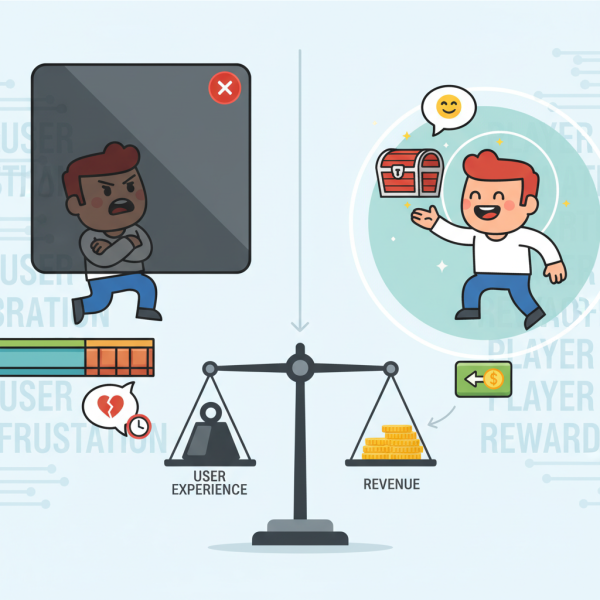
User Experience vs. Revenue
What you'll learn
 User Engagement StrategiesRewarded Video BenefitsInterstitial Ad DrawbacksMonetization Best Practices
Striking the right balance between effective monetization and a positive user experience is paramount. Developers constantly grapple with strategies to generate revenue without alienating their player base. While various ad formats exist, the stark contrast between opt-in rewarded videos and forced interstitial ads highlights a critical divergence in approach, one that profoundly impacts user sentiment, session length, and ultimately, a game's long-term success. Understanding this difference is key for any studio aiming to build sustainable and beloved titles.
The Interstitial Dilemma: A User's Frustration
Interstitial ads are full-screen advertisements that appear at natural transition points within a game, such as between levels, during loading screens, or after a significant in-game action. While they offer high visibility and can deliver strong immediate revenue, their forced nature often comes at a steep cost to the user experience. Players are abruptly pulled out of their immersive gameplay, compelled to wait for a timer to expire, or to actively find a small, often hidden, close button.
This disruption frequently leads to negative user sentiment. Players perceive these ads as intrusive, annoying, and a disrespectful interruption to their leisure time. The feeling of being forced to watch an ad, regardless of their current engagement or desire, can generate frustration and resentment. For developers, this translates to shorter session lengths as players grow weary and are more likely to abandon the game sooner. Over time, it can significantly harm retention rates, as frustrated users simply seek out alternative entertainment.
Rewarding Engagement: The Opt-In Advantage
In contrast, opt-in rewarded video ads put the power squarely in the player's hands. These ads are presented as an optional choice, offering a tangible in-game reward—such as extra currency, a bonus item, an additional life, or a reduction in wait time—in exchange for watching a short video advertisement. The crucial differentiator here is consent. Players choose to engage with the ad because they perceive a direct, beneficial value exchange.
This voluntary interaction fosters a significantly more positive user sentiment. Players appreciate the agency and the clear value proposition. They don't feel interrupted; they feel empowered to make a decision that directly benefits their gameplay. This positive reinforcement encourages engagement, as players actively seek out opportunities to earn rewards, thereby extending their session lengths and deepening their commitment to the game. When users view ads as a useful tool for progression rather than an obstacle, their overall satisfaction and loyalty increase dramatically.
The Psychology of Choice and Value Exchange
The success of rewarded videos is rooted in fundamental psychological principles:
- Autonomy: Humans crave control. Giving players the choice to engage with an ad respects their autonomy, making them feel like an active participant rather than a passive recipient.
- Reciprocity: When a game offers a clear benefit for watching an ad, players feel a sense of reciprocity. They are more willing to give their attention because they are receiving something valuable in return.
- Positive Reinforcement: Earning rewards through rewarded videos creates a positive feedback loop. This reinforces desired behaviors (watching ads) by associating them with a pleasant outcome (in-game benefits), which contrasts sharply with the negative experience often associated with forced interstitials.
Strategic Implementation of Rewarded Videos
Effective integration of rewarded videos requires thoughtful design and placement. It's not enough to simply offer them; they must be woven seamlessly into the game's economy and player journey:
- Contextual Integration: Offer rewarded videos at natural breakpoints or moments of player need. Examples include gaining an extra life after failing a level, speeding up a build timer, earning bonus currency, or unlocking exclusive content.
- Transparent Value: Clearly communicate the reward before the player opts in. Players should know exactly what they are gaining for their time, reinforcing the value exchange.
- Mindful Frequency: While opt-in, developers should still manage the frequency of rewarded video offers. Over-saturating the player with opportunities, even voluntary ones, can lead to fatigue.
- A/B Testing: Experiment with different reward types, values, placements, and frequencies to optimize engagement and find what resonates best with your specific player base. Data-driven decisions are crucial for maximizing their effectiveness.
Measuring Success: Beyond Ad Views
When evaluating the impact of rewarded videos versus interstitial ads, developers should look beyond simple ad impressions or click-through rates. Key metrics for success include:
- User Retention Rates: Are players sticking around longer? Games with positive ad experiences often see higher long-term retention.
- Average Session Length: Are players spending more time in the game per session, actively seeking out and engaging with rewarded video opportunities?
- In-App Purchase (IAP) Conversion: Sometimes, players who engage with rewarded videos are more likely to make IAPs, as the ads can serve as an indication of engagement with the app.
Comprehension questions
 What is the primary difference in approach between opt-in rewarded video ads and forced interstitial ads?How do interstitial ads typically impact user sentiment and session length?What psychological principles underpin the success of rewarded video ads?Name three best practices for strategically implementing rewarded videos into a game's economy.