
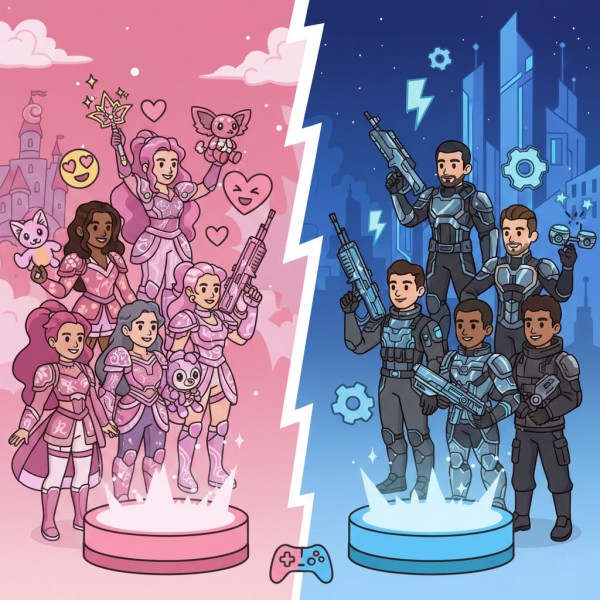
Key Differences Between Pink Market and Blue Market Video Games
What you'll learn
 Premium vs. Free-to-Play ModelsLive Service DevelopmentGame Monetization StrategiesPlayer Engagement and Retention
The video game industry, a landscape of constant evolution, frequently presents developers with strategic choices that define a project's trajectory and potential for success. Among the most fundamental of these choices is the target market and its associated business model. Two prevalent yet distinct approaches, often referred to as the "Pink Market" and "Blue Market" strategies, dictate not only how a game is sold but also its core design philosophy, development lifecycle, and player engagement strategies. Understanding these paradigms is crucial for any designer or developer aiming to build sustainable and impactful games.
Understanding the Blue Market Video Game
The Blue Market represents the traditional model of game development and sales. Historically, this has been the dominant paradigm, characterized by a premium, upfront purchase price. Players buy a complete game, either physically or digitally, and expect a full, self-contained experience for that initial cost.
Key characteristics of Blue Market games include:
- Single Purchase, Full Content: The primary monetization is the initial sale. Players gain access to the vast majority, if not all, of the core game content upon purchase.
- Emphasis on Launch Quality: Due to the upfront investment by players, there's immense pressure for the game to be polished, stable, and content-rich at launch. First impressions are paramount, and a poor launch can significantly damage sales and reputation.
- Finite Experience (Often): While many Blue Market games offer extensive replayability, a clear beginning and end, or a defined content scope, are common. Player retention after completing the main content typically relies on intrinsic enjoyment, multiplayer modes, or future expansions.
- Monetization through Expansions/DLC: Post-launch revenue often comes from significant content additions like story expansions, new character packs, or substantial gameplay modules, usually sold as separate, often sizable, purchases. Microtransactions for purely cosmetic items or minor convenience may exist but are typically supplementary, not foundational to the business model.
- Audience Expectation: Players expect a complete and robust experience commensurate with the premium price tag. Any additional monetization is often viewed critically if it feels like content was stripped from the base game.
For developers, the Blue Market demands a strong focus on delivering a comprehensive and high-quality product by the release date. Marketing efforts are heavily concentrated pre-launch, building anticipation and securing pre-orders. Post-launch support usually involves bug fixes, performance improvements, and eventually, the development and release of major paid expansions.
Exploring the Pink Market Video Game
In contrast, the Pink Market paradigm revolves around free-to-play (F2P) models and live service games, where the initial barrier to entry is low or non-existent. The core monetization strategy shifts from an upfront sale to continuous, optional purchases made by players over the game's lifespan.
Defining features of Pink Market games include:
- Free-to-Play Entry: The game is often free to download and play, attracting a massive potential audience. Revenue is generated from a smaller percentage of players who choose to spend money.
- Live Service and Content Updates: Pink Market games are designed for long-term engagement. This necessitates a constant stream of new content, events, features, and balance adjustments to keep players invested and encourage spending.
- Diverse Monetization Streams: Revenue comes from microtransactions, which can include cosmetic items (skins, emotes), convenience items (time savers, boosters), progression boosts, battle passes, loot boxes (gacha mechanics), and premium currencies. The goal is to encourage frequent, small purchases rather than a single large one.
- Engagement-Driven Design: Game mechanics are often designed to maximize player retention and engagement. Daily quests, seasonal content, social features, competitive ladders, and persistent progression systems are common. Analytics play a huge role in understanding player behavior and optimizing monetization funnels.
- Community as a Core Asset: Building and maintaining a strong community is vital for a Pink Market game's longevity. Active communication, listening to feedback, and addressing player concerns are ongoing responsibilities.
Developers in the Pink Market operate on an iterative, continuous development cycle. Teams often include dedicated live operations (live ops) personnel, community managers, and data analysts. The focus shifts from a single launch event to an ongoing process of content creation, balance tuning, and monetization optimization, often relying heavily on A/B testing and player data.
Core Differences in Design and Development Philosophy
The distinction between Pink and Blue Market games isn't merely about price; it permeates every aspect of game design and development:
- Monetization Strategy: Blue relies on value perceived at point of sale; Pink relies on value perceived over time, with optional purchases enhancing or customizing the experience.
- Content Delivery: Blue aims for a complete, often linear or sandbox experience at launch. Pink delivers content incrementally, often through seasons, events, or expansions designed to keep players returning.
- Player Retention: Blue relies on the inherent quality and replayability of the initial offering. Pink employs continuous incentives, progression systems, and social mechanics to maintain long-term engagement.
- Development Lifecycle: Blue market development is front-loaded, with a definitive release peak. Pink market development is an ongoing live service, requiring continuous content pipelines, frequent updates, and active community management.
- Risk Profile: Blue market games face high upfront development costs and depend heavily on launch sales for recoupment. Pink market games often have lower initial barriers (F2P) but require sustained player engagement and effective monetization strategies to generate consistent revenue. The risk shifts from a single launch gamble to the ongoing challenge of maintaining player interest and spending over years.
- Ethical Considerations: While both markets face ethical questions, the Pink Market often draws more scrutiny due to its reliance on psychological design principles to encourage spending, sometimes leading to accusations of "pay-to-win" or exploitative mechanics. Blue Market games, conversely, might face criticism for excessive day-one DLC or season passes that feel mandatory.
Strategic Considerations for Game Developers
Choosing between a Pink or Blue Market approach is a strategic decision that impacts every facet of a project. Developers must carefully weigh their target audience, game genre, creative vision, team capabilities, and business objectives.
For instance, a narrative-driven single-player RPG might naturally align with a Blue Market premium model, where the focus is on a meticulously crafted, complete story. Conversely, a competitive multiplayer shooter or a mobile puzzle game often thrives in the Pink Market, leveraging ongoing content, social features, and microtransactions to sustain engagement and revenue.
The lines between these markets are also increasingly blurring. Many premium Blue Market games now incorporate battle passes or cosmetic item shops. Some F2P Pink Market games offer large, paid expansions that resemble traditional DLC. These hybrid models attempt to leverage the strengths of both approaches, offering an upfront purchase while also providing avenues for ongoing engagement and optional monetization.
Regardless of the chosen model, ethical design practices remain paramount. Transparency with players, fair monetization strategies, and a focus on delivering genuine value are crucial for long-term success and maintaining player trust in both Pink and Blue Market environments.
Summary
The Pink Market and Blue Market represent fundamentally different approaches to video game development, monetization, and player engagement. The Blue Market adheres to a traditional premium pricing model, delivering a complete game for an upfront cost with an emphasis on launch quality and post-launch expansions. The Pink Market, conversely, embraces free-to-play and live service models, relying on continuous content updates, diverse microtransactions, and sustained player engagement for revenue. Understanding these distinctions is critical for developers to align their game design, production processes, and business strategies effectively, navigating the evolving landscape of the video game industry to achieve their creative and commercial goals.
Comprehension questions
 What is the primary monetization strategy for a Blue Market video game, and how does it typically generate post-launch revenue?List three defining characteristics of Pink Market games regarding content delivery and player engagement.How does the development lifecycle of a Blue Market game differ from that of a Pink Market game?Explain how the risk profile for game developers differs when pursuing a Pink Market versus a Blue Market strategy.