
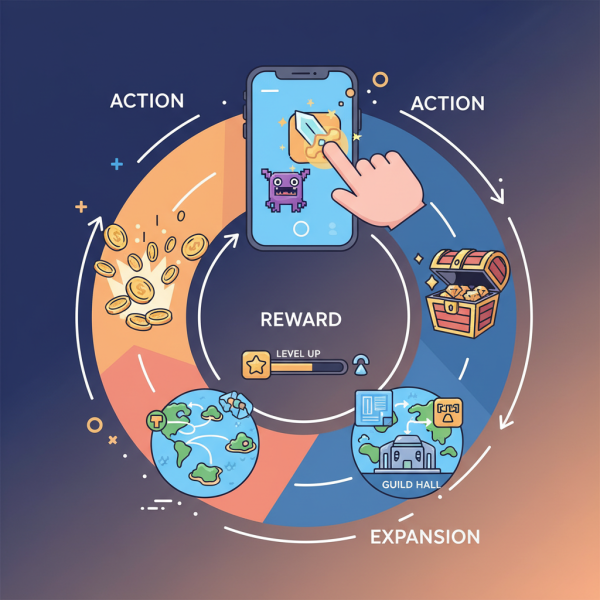
Action, Reward, and Expansion in Mobile Game Design
What you'll learn
 Core Gameplay Loop DesignPlayer Engagement StrategiesMobile Game Retention MechanicsGame Economy and Progression
The success of a mobile game hinges not just on its initial concept or graphical fidelity, but fundamentally on the strength and elegance of its core gameplay loop. For game designers and developers, understanding and meticulously crafting this cycle of "Action, Reward, and Expansion" is paramount. It is the rhythmic heartbeat that compels players to return daily, investing their time and attention, and ultimately drives long-term retention and monetization. This article will dissect each crucial phase of the loop, offering insights into how to optimize them to create an irresistibly engaging experience.
Understanding the Core Gameplay Loop
At its heart, the core gameplay loop is the repetitive cycle of activities and feedback that defines the minute-to-minute, hour-to-hour, and even day-to-day player experience. It's the engine that powers player engagement. In mobile games, this loop is often distilled into three primary components:
- Action: The player's direct input, challenge, or choice within the game. This is where skill is tested, decisions are made, and effort is exerted.
- Reward: The immediate or deferred positive reinforcement received by the player for performing an action. This could be currency, items, experience, or simply the satisfaction of progress.
- Expansion: The new opportunities, content, or system growth that emerges from the accumulation of rewards, providing new actions and deeper engagement pathways.
A well-designed loop creates a satisfying cadence, where each completed cycle naturally leads to the desire for the next, fostering a sense of continuous progression and discovery.
The "Action" Phase: Engaging Player Input
The Action phase is where the player actively participates. In mobile games, actions must be intuitive, accessible, and provide immediate, clear feedback. This doesn't necessarily mean simple; it means understandable within the context of the UI and game mechanics.
Consider the myriad forms an 'Action' can take:
- Tapping to attack enemies in an RPG.
- Swiping to match gems in a puzzle game.
- Strategically deploying units in a real-time strategy title.
- Making a critical build decision in a city-builder.
Every action, no matter how small, should feel meaningful. It should contribute to a larger objective, even if that objective is simply to clear the current challenge. Responsive controls, clear visual and audio cues, and a fair challenge curve are essential here. If the actions feel clunky, unresponsive, or pointless, players will quickly disengage.
The "Reward" Phase: Fueling Retention
Rewards are the lifeblood of the mobile game loop, validating player effort and providing tangible progress. They can be broadly categorized into extrinsic and intrinsic rewards.
Extrinsic Rewards: These are the quantifiable items players receive:
- Currency: Soft currency, hard currency, premium currency.
- Items: Equipment, consumables, crafting materials.
- Experience Points: Leading to level-ups and new abilities.
- Cosmetics: Skins, emotes, profile customization.
- Gacha Pulls: The chance for rare rewards.
The timing and presentation of rewards are crucial. Variable reward schedules, where the specific reward is unpredictable, can be incredibly powerful in fostering habitual play. Think about the psychological impact of a "loot box" or a daily login bonus. Rewards should be plentiful enough to feel generous but scarce enough to maintain their value and encourage continued play.
Intrinsic Rewards: These are less tangible but equally vital:
- Sense of Accomplishment: Overcoming a difficult challenge.
- Mastery: Improving skill over time.
- Social Recognition: Leaderboard positions, guild contributions.
- Narrative Progress: Unlocking new story segments.
A balanced approach, delivering both immediate, small rewards and larger, delayed rewards, creates a satisfying rhythm of gratification and anticipation.
The "Expansion" Phase: Sustaining Long-Term Engagement
Once players have cycled through action and reward a sufficient number of times, they inevitably seek something new. This is where the Expansion phase comes into play, providing depth, novelty, and new horizons for players to explore. Without effective expansion, even the most polished core loop will eventually grow stale.
Expansion can manifest in several ways:
- New Content: Adding new levels, characters, units, equipment, or story chapters.
- New Systems: Introducing crafting, guild mechanics, PvP arenas, or social features.
- Meta-Progression: Overarching systems that persist beyond individual play sessions, offering long-term goals and a sense of enduring investment. This could be base building, character talent trees, or collecting rare achievements.
- Live Operations: Seasonal events, limited-time challenges, and battle passes that continually refresh the player experience and offer new reward tracks.
Effective expansion deepens the core loop, offering new "Actions" to perform and new "Rewards" to earn, thereby restarting or significantly extending the player's engagement cycle. It's about providing a clear path forward, a reason to invest further, and new challenges to overcome.
Iteration and Optimization: Refining Your Loop
Designing a robust core gameplay loop is not a one-time task; it's an ongoing process of iteration and optimization. Data analytics are invaluable here, providing insights into player behavior: where they spend their time, where they drop off, which features are most utilized, and which rewards are most coveted. A/B testing different reward timings, challenge difficulties, or UI layouts can yield significant improvements.
Player feedback, gathered through surveys, community forums, or direct communication, also offers qualitative insights that data alone cannot provide. Understanding the "why" behind player actions is as important as understanding the "what." The goal is to continuously refine the friction points, enhance the satisfaction of rewards, and intelligently expand the game world, all while maintaining accessibility for the mobile platform.
Summary
Mastering the core gameplay loop of "Action, Reward, and Expansion" is fundamental for creating enduring mobile game success. Designers must meticulously craft intuitive actions, psychologically resonant rewards, and compelling expansion pathways to foster sustained player engagement. This iterative process, guided by data and player feedback, ensures the loop remains fresh and captivating, driving daily returns and long-term retention in a competitive market.
Comprehension questions
 What are the three primary components of the core gameplay loop discussed in the article?Beyond currency and items, what are some examples of intrinsic rewards, and why are they important for player retention?