
Exploring Ramp Up, Flat, Brick Wall, and Exponential Level Curves in Game Design
- -->> 4. Exploring Ramp Up, Flat, Brick Wall, and Exponential Level Curves in Game Design
What you'll learn
 Ramp Up Curve in Game DesignFlat Curve in Game DesignBrick Wall Curve in Game DesignExponential Curve in Game Design
Beyond the broader strokes of bell-shaped and reverse bell-shaped curves, game designers employ a more granular vocabulary to describe the nuances of difficulty progression. Among these, the ramp up curve, flat curve, brick wall curve, and exponential curve represent distinct approaches to managing the player's challenge, each with its own implications for player engagement and overall game feel. Understanding these specific curve types is essential for developers aiming to fine-tune the difficulty and create an experience that resonates with their target audience.
The Gentle Incline: The Ramp Up Curve
A ramp up curve describes a gradual and steady increase in difficulty throughout the game. Like a gentle slope, the challenges presented to the player progressively become more demanding, allowing ample time for learning and adaptation. New mechanics are often introduced early and explored in simpler contexts, with complexity being layered on incrementally. This approach prioritizes a smooth learning experience and aims to avoid overwhelming players at any stage.
Benefits of a Ramp Up Curve:
-
Excellent for Tutorials and New Players: The gradual increase in difficulty provides a comfortable onboarding experience, allowing newcomers to grasp core mechanics without feeling lost or incapable.
-
Builds Player Confidence: Successfully overcoming early, easier challenges fosters a sense of accomplishment and motivates players to tackle more difficult obstacles.
-
Allows for Nuanced Mechanic Introduction: Complex game systems can be introduced piece by piece, giving players the time to master each component before facing situations that require their combined use.
Games that work best with a Ramp Up Curve:
-
Strategy Games: These often have numerous interconnected systems that require time to understand. A ramp-up curve allows players to learn basic resource management and unit control before facing complex strategic scenarios.
-
Puzzle Games: Introducing new puzzle mechanics gradually, starting with simpler variations and progressively increasing complexity, is a hallmark of a ramp-up approach.
-
Action-Adventure Games with Deep Combat Systems: Players can learn basic attacks and movement before facing enemies that require advanced techniques like parrying, dodging, and utilizing different abilities.
The Steady State: The Flat Curve
A flat curve maintains a relatively consistent level of difficulty throughout the majority of the game. While some minor fluctuations might occur, the core challenge presented to the player remains largely unchanged. This approach can be used to emphasize other aspects of the game, such as narrative, exploration, or social interaction, without significant pressure from increasing difficulty.
Benefits of a Flat Curve:
-
Focus on Non-Difficulty Aspects: Allows players to concentrate on the story, world-building, or other non-combat or puzzle-related elements without being constantly challenged by escalating difficulty.
-
Predictable Experience: Players generally know what to expect in terms of challenge, which can be appealing to those seeking a more relaxed or consistently paced experience.
-
Can Highlight Player Skill Growth: While the game's difficulty doesn't increase, players may still feel a sense of progression as they become more proficient with the game's systems and overcome challenges more efficiently.
Games that work best with a Flat Curve:
-
Narrative-Driven Adventure Games: Games where the story and character development are the primary focus may opt for a flat curve to avoid interrupting the narrative flow with significant difficulty spikes.
-
Exploration-Focused Games: Titles that emphasize discovering secrets and traversing the game world might benefit from a consistent level of challenge that doesn't overly punish exploration.
-
Casual Games: Games designed for relaxation and enjoyment often employ a flat curve to maintain accessibility and avoid frustration.
The Sudden Obstacle: The Brick Wall Curve
A brick wall curve is characterized by a sudden and significant spike in difficulty at a specific point in the game. Players may progress through a relatively smooth or moderately increasing level of challenge, only to encounter an obstacle that demands a drastically higher level of skill, knowledge, or specific strategies.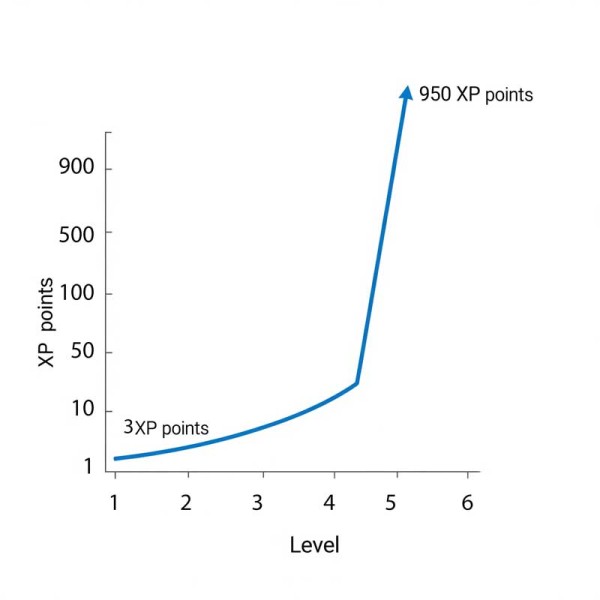
This image to the right, while a tad bit extreme, domenstrates a sudden and abrupt difficulty increase once the place reaches a certain point. This can manifest as a particularly difficult boss fight, a complex puzzle, or a section with overwhelming enemy encounters.
Benefits of a Brick Wall Curve:
-
Creates Memorable Challenges: Overcoming a significant difficulty spike can be a very rewarding experience and create lasting memories for players.
-
Tests Player Mastery: Brick walls can force players to fully utilize all the skills and knowledge they have accumulated throughout the game.
-
Can Serve as a Gatekeeper: Designers might strategically place brick walls to ensure players are adequately prepared for later, more challenging content.
Games that work best with a Brick Wall Curve:
-
Classic Arcade Games: Many older arcade titles featured challenging "walls" that players had to overcome through practice and pattern recognition.
-
Boss-Focused Games: Games that heavily emphasize challenging boss encounters often employ a brick wall curve leading up to each major boss.
-
Games with a High Skill Ceiling: Titles that reward mastery of complex mechanics might feature brick walls to differentiate more skilled players.
Potential Drawbacks: Brick wall curves can also lead to player frustration and abandonment if the difficulty spike is perceived as unfair or too abrupt. Careful balancing and providing players with the tools to overcome the challenge are crucial.
The Relentless Ascent: The Exponential Curve
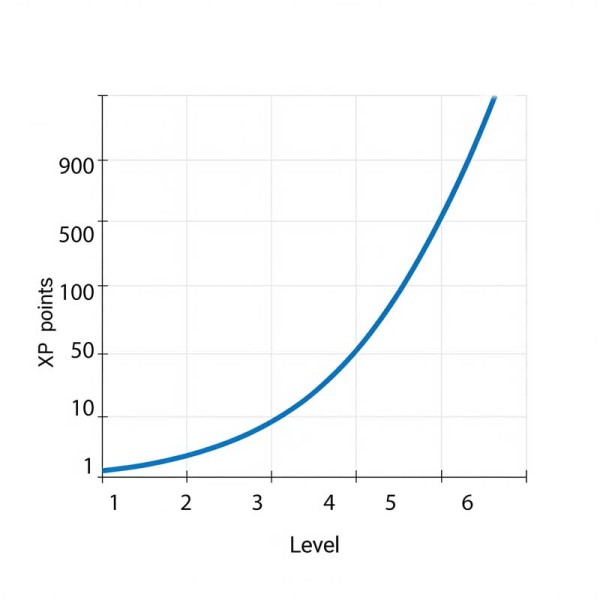 An exponential curve features a difficulty that increases at an accelerating rate as the player progresses. The initial challenges might be manageable, but the difficulty quickly escalates to become significantly more demanding in later stages. This image to the right demonstrates a continuously increasing level curve where each new level requires more XP then the level prior. This type of curve is often seen in games designed for highly skilled players seeking a relentless test of their abilities.
Benefits of an Exponential Curve:
-
Provides a Continuous and Growing Challenge for Skilled Players: Keeps experienced players engaged by constantly raising the stakes and demanding increasingly precise execution and strategic thinking.
-
Can Create a Strong Sense of Accomplishment for Late-Game Progression: Reaching the end of a game with an exponential difficulty curve can feel like a significant achievement.
-
Suits Games with a High Replayability Factor: The extreme difficulty can encourage players to revisit the game and further hone their skills.
Games that work best with an Exponential Curve:
-
Hardcore Action Games: Games known for their high difficulty and demanding combat systems often utilize an exponential curve.
-
Competitive Games: While not always strictly a level curve within a single playthrough, competitive games often feature a form of exponential difficulty as players climb the ranks and face increasingly skilled opponents.
-
Certain Roguelikes and Roguelites: The escalating challenges in these genres can often feel exponential as players delve deeper into procedurally generated environments.
Potential Drawbacks: Exponential curves can be very punishing and may alienate players who are not prepared for the rapidly increasing difficulty. They require careful balancing to ensure the challenge remains engaging rather than insurmountable.
Summary
Level curves in video game design can take various forms beyond simple linear progression. A ramp up curve provides a gentle and gradual increase in difficulty, ideal for onboarding new players and introducing complex mechanics. A flat curve maintains a consistent level of challenge, allowing focus on other game aspects like narrative or exploration. A brick wall curve introduces a sudden and significant difficulty spike at a specific point, testing player mastery and creating memorable obstacles. Finally, an exponential curve features a rapidly accelerating increase in difficulty, catering to highly skilled players seeking a relentless challenge. The choice of which curve to implement depends on the game's design goals, target audience, and the desired player experience.
Comprehension questions
 Describe the main characteristic of a "brick wall curve" and what potential impact it can have on players.What type of game might benefit most from a "flat curve" and why?Explain why a "ramp up curve" is often effective for introducing complex game mechanics.What is the key difference between a "ramp up curve" and an "exponential curve"?
Review Quiz
Next Lesson

Related Content

Level Curves - The Art of Designing In Game Progression
A level curve is a function that maps a player's experience points (XP) to their character level. It's the engine that drives a player's journey from novice to master.


Example Level Curve Formulas for Game Progression
A level curve formula serves as a predictable and scalable method for determining the XP thresholds for each level in a game...

Understanding Bell and Reverse Bell-Shaped Level Curves in Game Design
The careful orchestration of difficulty is paramount to crafting an engaging and rewarding video game experience. Too easy, and players become bored and disengaged...
Level Curve Design
A video game's level curve is the silent conductor of its difficulty, orchestrating the player's journey from novice to master...

Course Contents : Fundamentals of Level Curve Design
- >> 4.
 Exploring Ramp Up, Flat, Brick Wall, and Exponential Level Curves in Game Design