In-Game Economies: Balancing Currencies and Preventing Inflation
- -->> 2. In-Game Economies: Balancing Currencies and Preventing Inflation
What you'll learn
 In-game currency typesFountains and drains in economiesInflation prevention strategiesEconomic monitoring and adjustment
The Delicate Balance of Game Economies
Game economies are intricate systems vital to player engagement and retention. A poorly managed economy can lead to player dissatisfaction, perceived unfairness, and ultimately, a decline in active users. Central to any robust in-game economy is the careful design and management of its currencies, particularly the distinction between hard and soft currencies, and the crucial concept of "fountains and drains" to prevent runaway inflation. Mastering these elements ensures a healthy, long-lasting virtual ecosystem where player effort feels rewarded and progression remains meaningful.
Understanding Hard vs. Soft Currency
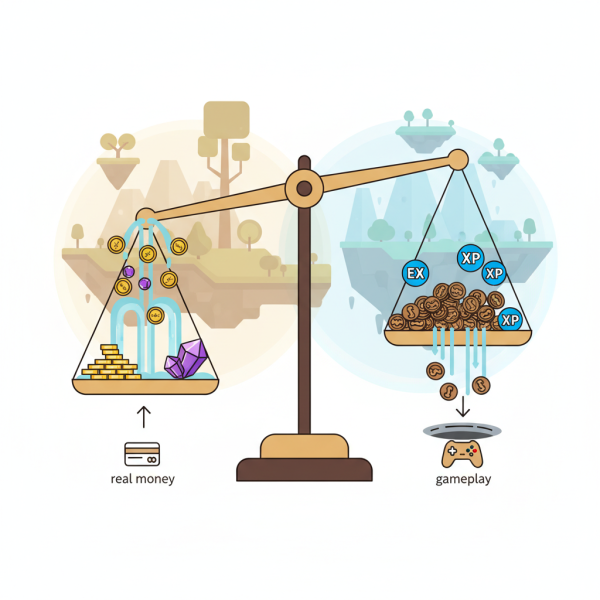
Hard currency typically represents premium, real-money purchased currency. It often drives monetization strategies and provides a direct revenue stream for developers. Examples include "gems," "crystals," or "gold bars" bought with real-world money. Hard currency usually has a fixed value, is scarce, and is used for high-value transactions, accelerating progress, or acquiring exclusive items. Its primary function is often to bridge the gap between players who invest time and those who invest money.
Soft currency, on the other hand, is earned through gameplay. This could be "coins," "gold," "experience points," or "resources" acquired by completing quests, defeating enemies, or performing in-game actions. Soft currency is generally abundant, often having a higher velocity within the economy, and is used for regular progression, purchasing common items, upgrades, or entry fees for activities. Its primary purpose is to reward player engagement and facilitate core gameplay loops.
The balance between these two is critical. Hard currency should offer convenience or exclusivity without entirely devaluing the effort required to earn soft currency. If players can simply buy their way to everything, the motivation to play and earn soft currency diminishes. Conversely, if hard currency offers too little value, the monetization aspect suffers.
The Fountains and Drains Metaphor
The "fountains and drains" metaphor is fundamental to economic stability. Fountains are all the sources from which currency enters the game economy. These include quest rewards, loot drops, daily bonuses, selling items to NPCs, or achievements. Drains are all the points where currency exits the economy. This encompasses purchasing items from vendors, upgrading equipment, crafting costs, repair fees, travel costs, or paying for services.
A healthy economy requires a careful balance. If fountains generate too much currency without sufficient drains, the economy experiences inflation. Currency becomes less valuable, items become more expensive, and players may feel their time investment is not adequately rewarded. Conversely, if drains are too aggressive or fountains too scarce, players may struggle to acquire enough currency, leading to frustration and a sense of stagnation.
Strategies for Inflation Prevention
Preventing inflation is an ongoing process that requires diligent design and monitoring. Several strategies can be employed to manage the flow of currency effectively:
- Controlled Fountains: Limit the amount of currency generated. This can involve daily caps on rewards, scaling rewards based on difficulty rather than time, or ensuring that new content doesn't simply flood the market with more currency.
- Diverse Drains: Implement various types of drains that appeal to different player motivations.
- Consumable Drains: Items that are used up, requiring players to spend repeatedly (e.g., potions, ammunition).
- Investment Drains: One-time, high-cost purchases that provide lasting value (e.g., character upgrades, rare cosmetic items, player housing).
- Maintenance Drains: Recurring costs essential for gameplay (e.g., repair costs, subscription-like fees for certain services).
- Randomization Drains: Gacha mechanics or loot boxes (when ethical and transparent) can act as significant drains, as players spend currency with no guaranteed return on specific items.
- Dynamic Pricing: While complex, some economies might implement dynamic pricing for certain items, adjusting costs based on supply and demand or overall currency velocity. This can help stabilize prices organically.
- Time Sinks & Grind: The inherent "grind" in many games serves as an indirect drain. If players must invest significant time to earn currency for an item, the real-world value of that currency is perceived as higher, slowing down inflation.
- Currency Sinks: Introducing exclusive, extremely high-cost items or cosmetic rewards that serve no gameplay function but act purely as status symbols can effectively remove vast amounts of currency from the system for aspirational players.
Monitoring and Adjusting Your Economy
A game economy is a living system that needs continuous observation.
- Data Analytics: Track currency generation rates, spending habits, popular purchase items, and average player wealth over time. Identify trends and anomalies.
- Player Feedback: Listen to your community. Are players complaining about a lack of currency, or conversely, that everything is too cheap? Are they struggling to progress without paying?
- Iterative Adjustments: Be prepared to make small, incremental changes. Large, sudden changes can disrupt player trust and cause resentment. Test changes internally before rolling them out widely.
- Event-Based Management: Use limited-time events, special sales, or unique item releases to create temporary fountains or drains, injecting novelty and managing currency flow.
Conclusion
Building and maintaining a balanced in-game economy is an ongoing challenge that requires foresight, careful design, and continuous vigilance. By thoughtfully distinguishing between hard and soft currencies, meticulously balancing "fountains" (currency generation) with "drains" (currency sinks), and implementing strategic measures to prevent inflation, developers can create a robust, engaging, and sustainable virtual world. A healthy economy ensures that player effort is consistently rewarded, progression feels meaningful, and the game remains enjoyable for years to come.
Comprehension questions
 What is the primary distinction between hard and soft currencies in a game economy?Why is continuous monitoring and iterative adjustment important for a healthy in-game economy?
Review Quiz
Next Lesson
Course Contents : Mobile Game Monetization Strategies
- >> 2.
 In-Game Economies: Balancing Currencies and Preventing Inflation