Understanding Physics Engines in Game Development
- -->> 1. Understanding Physics Engines in Game Development
What you'll learn
 Key Components of a Physics EngineHow Physics Engines Work in GamesBenefits for Game DevelopmentPhysics Engines in Mobile Games
Introduction
Physics engines are the unsung heroes of interactive entertainment, silently orchestrating the realism and responsiveness we've come to expect from modern video games. From a character's fall to the shattering of a virtual window, these sophisticated systems govern how objects behave in a digital world. For game designers and developers, understanding the intricacies of physics engines is not just beneficial; it's essential for crafting believable, engaging, and performant game experiences across various platforms, including the increasingly popular mobile gaming sector. This article will delve into what physics engines are, their core components, their application in games, and the specific considerations for mobile development.
What is a Physics Engine?
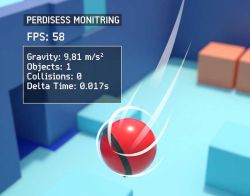
At its core, a physics engine is a software component that simulates real-world physics laws within a virtual environment. It takes into account properties such as mass, friction, gravity, velocity, and force to predict and calculate how objects will interact with each other and their surroundings. Without a physics engine, every interaction in a game would need to be meticulously hand-animated and scripted, leading to an incredibly static and unrealistic experience. Its primary goal is to provide a consistent and plausible physical simulation, allowing for dynamic and emergent gameplay.
Key Components of a Physics Engine
A typical physics engine is comprised of several interconnected modules, each handling a specific aspect of the simulation:
- Collision Detection: This module is responsible for identifying when two or more objects in the game world are overlapping or touching. It uses various algorithms, such as bounding volume hierarchies (BVH) or spatial partitioning (octrees, quadtrees), to efficiently narrow down potential collision pairs before performing more precise tests. This is a critical first step, as without knowing objects are interacting, no physical response can occur.
- Collision Response (Resolution): Once a collision is detected, this component determines how the objects should react. It calculates the forces and impulses required to prevent objects from interpenetrating and to simulate realistic bounces, slides, or crumpling. This often involves solving complex equations to ensure energy conservation and proper object separation.
- Rigid Body Dynamics: Most physics engines primarily deal with rigid bodies – objects that do not deform or change shape under stress. This module calculates the linear and angular motion of these objects based on applied forces, torques, gravity, and collisions. It involves integrating velocities and positions over time, often using numerical integration methods like Euler or Verlet integration.
- Soft Body Dynamics (Advanced): While more computationally intensive, some advanced physics engines can simulate soft bodies, which can deform, stretch, and bend (like cloth, fluid, or deformable materials). This adds another layer of realism but comes with a significant performance cost, often reserved for high-fidelity simulations or specific visual effects.
- Constraints: Constraints define how objects are restricted in their movement relative to each other. Common examples include hinges (allowing rotation around an axis), sliders (allowing movement along an axis), and joints (like character skeletons). These are crucial for building complex mechanical systems, character animations, or interactive environments.
How Physics Engines Work in Games
A physics engine typically operates within the game's main loop, often running at a fixed timestep independent of the rendering framerate to ensure determinism and stability.
- Input Collection: The engine gathers data on all active physical objects, their properties (mass, friction, restitution), and any forces currently being applied (gravity, player input, explosions).
- Collision Detection: It identifies all potential and actual collisions between objects.
- Collision Resolution: It calculates the appropriate responses to these collisions, preventing interpenetration and applying impulses.
- Integration: Based on forces, torques, and collision responses, the engine updates the linear and angular velocities, and subsequently the positions and orientations of all rigid bodies.
- Synchronization: The updated physical states (positions, rotations) are then passed back to the game engine for rendering and other game logic.
This iterative process, often performed multiple times per game frame (substepping), ensures a smooth and stable simulation.
Benefits for Game Development
Integrating a physics engine offers numerous advantages for game designers and developers:
- Realism and Immersion: Physics engines significantly enhance the believability of a game world. Objects react realistically to forces, collisions, and gravity, creating a more immersive experience that feels natural to the player.
- Emergent Gameplay Mechanics: Designers can leverage physics to create dynamic gameplay scenarios that might be impossible or too time-consuming to script manually. Think of destructible environments, complex vehicle interactions, or ragdoll effects.
- Prototyping and Iteration: Physics engines allow for rapid prototyping of new mechanics. Designers can quickly test different object properties or environmental interactions without needing extensive custom animation or scripting.
- Reduced Development Time: By automating the complex calculations of physical interactions, developers save countless hours that would otherwise be spent hand-crafting animations and collision responses for every possible scenario.
Challenges and Considerations
While powerful, physics engines present their own set of challenges:
- Performance Overhead: Physics calculations are computationally intensive, especially with a large number of interacting objects, complex collision shapes, or soft body simulations. Optimizing performance is crucial, particularly for mobile platforms.
- Deterministic Behavior: Ensuring that a physics simulation yields the exact same results every time, regardless of the platform or slight variations in input, is critical for multiplayer games and replay systems. This can be challenging due to floating-point precision issues across different hardware.
- Debugging Complex Interactions: When physics behave unexpectedly (e.g., objects phasing through walls, unstable stacks, or "jitter"), diagnosing the root cause can be difficult due to the complex interplay of forces, constraints, and collision events.
- Gaps in Realism: While engines aim for realism, they often use approximations to stay performant. This can lead to situations where "game physics" diverge from actual real-world physics, requiring careful tweaking to achieve desired results.
Physics Engines in Mobile Games
Mobile game development introduces unique constraints that heavily influence physics engine selection and implementation:
- Limited Resources: Mobile devices have less powerful CPUs, GPUs, and more stringent battery life considerations compared to PCs or consoles. Physics calculations must be highly optimized to run smoothly without draining the battery.
- 2D vs. 3D Physics:
- 2D Physics: Engines like Box2D or Chipmunk are exceptionally popular for mobile 2D games (e.g., Angry Birds, platformers). They are lightweight, efficient, and specifically designed for flat-plane interactions, making them ideal for the resource constraints of mobile devices.
- 3D Physics: For 3D mobile games, developers often use integrated solutions (Unity's PhysX, Unreal's Chaos) or highly optimized versions of standalone engines like Bullet. Aggressive culling, simpler collision shapes, and fewer active physics objects are common optimization strategies.
- Optimization Strategies:
- Using convex collision meshes instead of complex concave ones.
- Reducing the number of active physics objects or putting distant objects to sleep.
- Adjusting physics simulation frequency.
- Baking physics interactions into animations where possible for static or less interactive elements.
- Careful management of memory footprint.
Conclusion
Physics engines are indispensable tools for modern game development, providing the backbone for dynamic, interactive, and believable virtual worlds. From detecting collisions to simulating complex rigid body dynamics, they free developers from manually scripting every interaction, allowing for more creative freedom and emergent gameplay. While offering immense benefits in realism and efficiency, understanding their computational demands and specific challenges, particularly in the resource-constrained environment of mobile gaming, is crucial. By mastering the application and optimization of these powerful systems, game designers and developers can elevate their creations to deliver truly immersive and engaging experiences.
Comprehension questions
 What are the primary responsibilities of the Collision Detection and Collision Response modules within a physics engine?Explain two significant benefits that physics engines bring to the game development process.Name three challenges or considerations that developers face when implementing physics engines in their games.How do the resource constraints of mobile devices specifically influence the choice and optimization of physics engines for mobile games?
Community Poll
Next Lesson

Course Contents : Understanding Physics Engines in Game Development
- >> 1.
 Understanding Physics Engines in Game Development