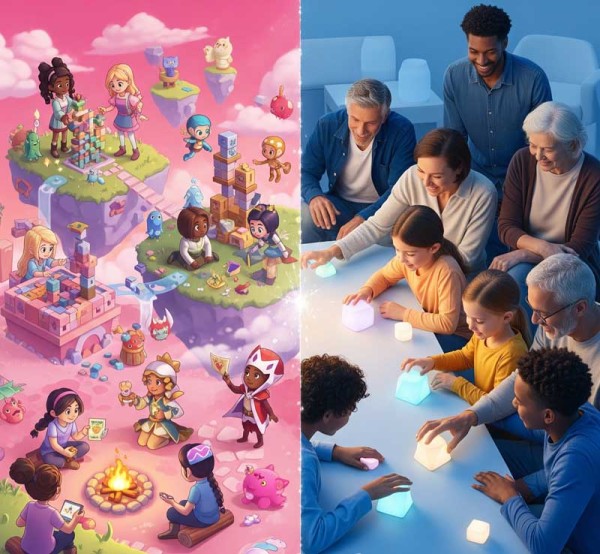
Pink vs. Blue Market Gaming Strategies
- -->> 3. Pink vs. Blue Market Gaming Strategies
What you'll learn
 Pink Market vs Blue MarketBenefits and Challenges of Design
In the ever-evolving world of video game design, developers often consider a game’s core mechanics and market strategy, but just as important is the target audience. Two distinct approaches, the Pink Market and the Blue Market, provide a useful framework for understanding how to design games for specific demographics. These concepts, a spin on the familiar business strategies, help game creators navigate their creative decisions and maximize their game's potential by focusing on who they're trying to reach.
What is a Pink Market Game?
A Pink Market game is one specifically designed for the female demographic. The "pink" in the name is a nod to the historical association of the color with girls and women. This market is not a single genre but rather a collection of games tailored to interests that historically resonate with female players, such as fashion design, home and life simulation, social networking, and narrative-heavy experiences. Games in this category often prioritize creativity, social interaction, and storytelling over intense competition or fast-paced action.
Market Potential and Challenges
The market potential for Pink Market games is significant and growing. With a global audience of female gamers expanding rapidly, titles that cater to this group can find a large and dedicated player base. Many established franchises, like The Sims and Animal Crossing, have successfully tapped into this market. However, there are significant challenges. The key is to avoid stereotypes and tokenism. A game designed for a female audience must be authentic, respectful, and thoughtfully crafted. Developers face the challenge of creating experiences that are both appealing and innovative, moving beyond simplistic concepts and embracing the diverse interests of female players.
-
Benefits:
-
Large and growing audience with strong engagement and community potential.
-
Opportunity to innovate in genres that are often underrepresented.
-
Can build strong brand loyalty if the game truly resonates with its audience.
-
-
Challenges:
-
Risk of falling into gender stereotypes.
-
Requires a deep understanding of the target audience’s diverse interests.
-
The market can be competitive with a few dominant players.
-
What is a Blue Market Game?
A Blue Market game is a title that targets an entirely new, often unconventional audience, moving beyond traditional gamer demographics. The "blue" here represents the wide-open, uncrowded space of an unexplored market. This isn’t just about creating a new genre; it’s about identifying a group of people who are not typically considered gamers and designing an experience that uniquely appeals to them. A great example of a Blue Market game would be Wii Sports when it first launched. It didn't just target a casual gaming audience; it appealed to an older demographic and entire families who had never considered themselves "gamers."
Market Potential and Challenges
The market potential for a Blue Market game is immense because you are creating demand rather than competing for it. By reaching a new audience, you can become the sole leader in that space, building a loyal community from the ground up. This can lead to groundbreaking commercial success. However, the challenges are equally large. There is no existing audience to target, so you have to educate and entice a new group of players. This requires a strong vision and a deep understanding of what motivates this new demographic. The risks are also higher; a Blue Market game could fail to find an audience, as its core concept may be too foreign or simply not compelling enough. There is no safety net of an existing fan base to fall back on.
-
Benefits:
-
The potential to create a dominant, uncontested market space.
-
Freedom to experiment with unique mechanics and concepts.
-
Can build a highly loyal and dedicated community.
-
-
Challenges:
-
No existing audience to market to, requiring a significant effort to create demand.
-
High risk of failure if the game's appeal is misunderstood or falls short.
-
Unpredictable development hurdles since there are no existing templates or benchmarks.
-
Benefits and Challenges of Design
The design philosophy for each market is fundamentally different. For a Pink Market game, the focus is on understanding the nuances of an established audience's preferences. This means extensive research, community feedback, and a commitment to authenticity. The challenge is to innovate within a framework without resorting to cliches.
For a Blue Market game, the design process is more exploratory. You're building from the ground up, with a focus on simple, intuitive mechanics that don’t require prior gaming knowledge. The challenge is to find that elusive "hook" that will resonate with an audience that isn’t actively looking for games. The design must be so compelling that it transcends the typical boundaries of gaming.
Summary
The choice between a Pink Market and a Blue Market strategy is a critical one for game developers. A Pink Market approach involves targeting a growing, yet often underserved, female audience with authentic and thoughtful experiences. This path offers a proven audience but requires careful design to avoid stereotypes. A Blue Market approach, on the other hand, involves creating a game for a completely new, non-traditional audience, sidestepping competition. This path offers immense potential for dominance but carries significant risks due to the lack of a built-in player base. Each strategy requires a different approach to design, marketing, and understanding the player, with the ultimate goal of creating a game that truly connects with its intended audience.
Comprehension questions
 What is the main difference between a "Pink Market" and a "Blue Market" game?What is a key benefit and a significant challenge of designing a game for a "Pink Market"?Why is the market potential for a "Blue Market" game considered so vast, and what is the primary risk associated with this?In the context of game design, how does the development process for a "Blue Market" game differ from a "Pink Market" game?
Review Quiz
Next Lesson

Related Content

Red vs. Blue Ocean Gaming Strategies
In the vast and ever-expanding world of video games, developers face a critical choice that can determine a game's fate: do you compete in an existing market or create a new one? This fundamental ...

Course Contents : Laying the Groundwork: The Game Design Phase
- >> 3.
 Pink vs. Blue Market Gaming Strategies