Laying the Groundwork: The Game Design Phase
Course Details
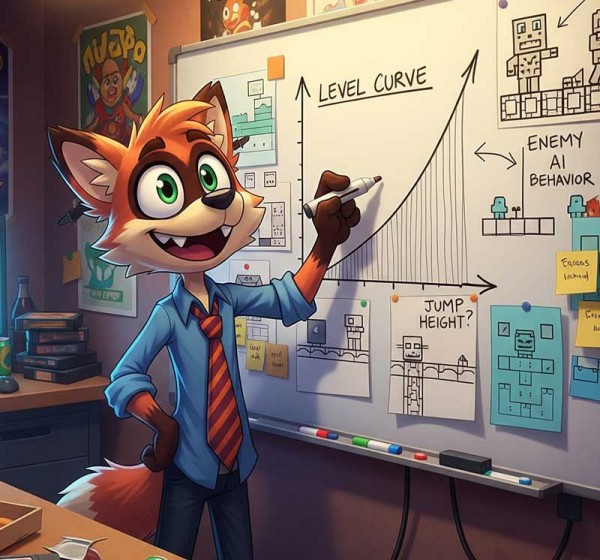
The Game Design Phase is the foundational stage of video game creation, where a raw idea is meticulously planned and transformed into a solid blueprint. This phase is less about building the game and more about defining its purpose, core mechanics, and overall vision. It's where you answer fundamental questions about what the game is, who it's for, and why it will be fun. A successful design phase saves immense amounts of time and resources down the line, as it prevents costly missteps and ensures the entire development team is working toward a unified goal.
Understanding Market Potential
A critical part of the design phase is understanding your game’s market potential. This involves identifying the target audience and analyzing the competitive landscape. You must decide whether your game is a Red Ocean title, entering a saturated market with fierce competition, or a Blue Ocean game, which seeks to create an entirely new market space. Understanding this distinction is key. For a Red Ocean game, the design must focus on a unique selling point that distinguishes it from rivals. For a Blue Ocean game, the design must be so innovative that it creates its own demand. This market analysis informs everything from gameplay to art style and monetization strategy.
The Power of Paper Apps and UI Mockups
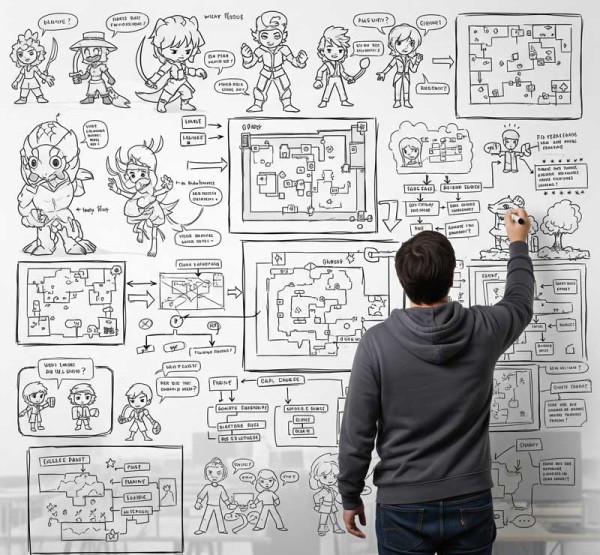
Before a single line of code is written, a game's design can be tested with paper apps and UI mockups. A paper app is a simple, non-digital prototype, often just drawings on a whiteboard or a notebook. It allows designers to rapidly sketch out user flows, menu navigation, and core gameplay concepts. This is the fastest, cheapest way to test if a game's loop is intuitive and logical.
UI mockups are more detailed visual representations of the game’s user interface. They show what the menus, HUD, and other on-screen elements will look like, without being functional. By creating these mockups early, developers can iterate on designs quickly and cheaply. Changing a UI element in a mockup takes minutes, while the same change in a live game build could take days of a programmer's time. Together, these tools serve as a visual guide and a shared language for the entire development team.
Gaining Early Consumer Insights
The design phase is also the ideal time to gather early consumer insights. This involves getting feedback from potential players on the game’s core concept, even when it's just a set of ideas or some rough sketches. Methods for this include:
-
Testing marketing creatives: Using concept art or short video clips to gauge interest and emotional response from a target audience.
-
Prototype feedback: Having players interact with a simple, non-polished prototype to observe their reactions and get their thoughts on the core mechanics.
This early feedback is invaluable. It can confirm if the game's core "hook" is appealing and can prevent the team from investing years of work into a concept that players don't find engaging. It's a proactive measure that mitigates risk and ensures the game is built with the player in mind from the very beginning.
Purpose of this course
The game design phase is a critical period of planning and conceptualization. In this course you will explore basic marketing concepts, purposes of simple UI mockups and paper apps as well as understanding the value of basic consumer testing. By prioritizing the design phase, a development team creates a robust blueprint that guides the entire production process, leading to a more focused, coherent, and successful final product.
Course Contents (6 lessons)
- 1.
 In the journey of creating a video game, the Early Design Phase is the most critical and foundational stage. This period, which occurs long before any serious coding or asset creation begins, is where the game's core concept is born and solidified.
 - 2.
 In the vast and ever-expanding world of video games, developers face a critical choice that can determine a game's fate: do you compete in an existing market or create a new one? This fundamental decision is at the heart of the "Red Ocean" and "Blue Ocean" strategies, a business framework adapted for the unique challenges of game design.
 - 3.
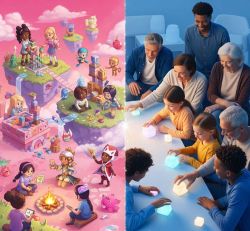 Unveiling Untapped Audiences: Pink vs. Blue Market Gaming Strategies In the ever-evolving world of video game design, developers often consider a game’s core mechanics and market strategy, but just as important is the target audience. Two distinct approaches, the Pink Market and the Blue Market, provide a useful framework for understanding how to design games for specific demographics.
 - 4.
 In the fast-paced world of video game development, the temptation is often to jump straight into coding and creating dazzling 3D models. However, a crucial, often overlooked step that can save time, money, and headaches is creating early-stage UI mockups.
 - 5.
 Before a single line of code is written or a single pixel is rendered, a great video game begins with an idea. The "paper app" is a crucial, foundational step in transforming that idea into a tangible concept. A paper app is a non-digital, low-fidelity prototype of a game's core systems and user experience.
 - 6.
 Before a game hits the market, a developer's vision is a fragile thing, shaped by passion and countless hours of work. But passion isn’t enough to guarantee success. This is where early-stage consumer insights testing becomes invaluable.