Prototyping and Core Loop Validation
- -->> 3. Prototyping and Core Loop Validation
What you'll learn
 Rapid Prototyping PrinciplesCore Loop DesignFun Factor ValidationIterative Development Benefits
The journey from a nascent idea to a fully realized interactive experience is fraught with challenges and uncertainties. Among the most critical phases for mitigating risks and ensuring a compelling player experience is Prototyping and Core Loop Development. This crucial stage involves rapidly constructing playable versions of a game's fundamental mechanics, not for visual fidelity, but purely to test their viability, explore design possibilities, and most importantly, validate the inherent fun factor of the game.
The Essence of Prototyping
Prototyping is essentially the experimental heart of game development. It's about bringing an abstract concept into a tangible, albeit unpolished, form as quickly and economically as possible. The primary goal is to answer critical questions about gameplay mechanics: Does this system work as intended? Is it intuitive? Is it enjoyable? By creating these mini-games or isolated feature tests, developers can confront assumptions early on, identifying potential flaws or areas for improvement before significant resources are committed to full-scale production.
Unlike a demo, which aims to showcase a polished slice of the game, a prototype is raw and focused. Its success isn't measured by graphical fidelity or extensive content, but by the clarity of the insights it provides into the core gameplay. It's a low-cost, high-yield method for exploring various design directions and understanding player interaction.
Understanding the Core Loop
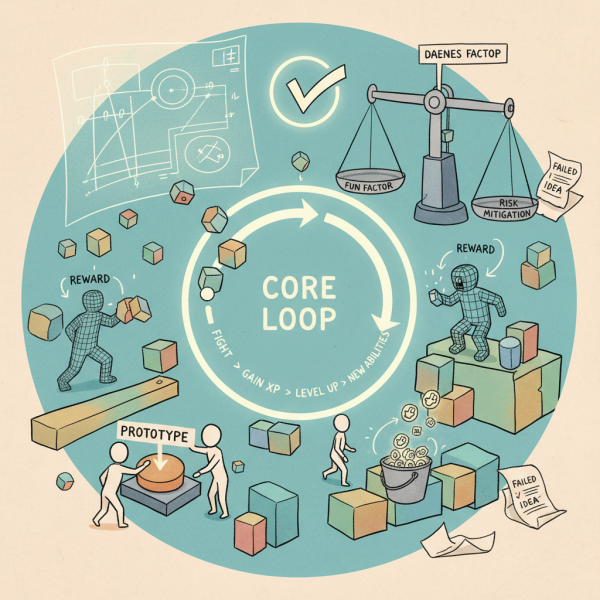
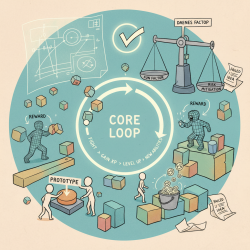
At the very heart of any engaging game lies its core loop. This fundamental concept describes the repeating cycle of player actions and reactions that drives the gameplay experience. It typically involves a player performing an action, receiving a reward or feedback, and then being motivated to perform the action again, often with slight variations or increasing complexity. For example, in an action RPG, the loop might be: fight enemies > gain experience > level up > unlock new abilities > fight stronger enemies. In a crafting game, it could be: gather resources > craft item > use item > enable new gathering opportunities.
Developing a compelling core loop is paramount because it forms the persistent rhythm of the game. If this loop isn't inherently satisfying, motivating, and clear, players will quickly lose interest, regardless of how beautiful the graphics or extensive the lore. Prototyping allows developers to isolate and refine this loop, ensuring that the foundational player experience is robust and enjoyable before layering on additional features and content.
Rapid Prototyping Techniques
Speed is the defining characteristic of effective prototyping. The objective is not to build a perfect mini-game but to quickly construct a functional skeleton that can be played and evaluated. This often means embracing simplicity and using existing tools and assets whenever possible. Developers might use basic shapes and colors, placeholder art, or even leverage off-the-shelf game engines and frameworks to accelerate the creation process.
The iterative nature of rapid prototyping is key. It's a continuous cycle of building, testing, analyzing feedback, and refining. Each iteration brings the team closer to a validated core mechanic or a clear understanding of why a certain idea doesn't work. This agility prevents teams from investing too much time and effort into unproven concepts.
- Focus on a Single Mechanic: Isolate and test one core idea at a time to get clear feedback.
- Embrace Placeholders: Don't waste time on polished art or sound; functionality is king.
- Test Early and Often: Get prototypes into the hands of players as soon as they are playable.
- Be Ready to Discard: Not every idea will work; be prepared to iterate or move on.
Validating Fun Factor and User Experience
Ultimately, the goal of prototyping the core loop is to validate the "fun factor" – the elusive quality that makes a game engaging and replayable. This validation isn't purely subjective; it involves careful observation and analysis of player behavior and feedback. User testing is invaluable here, allowing developers to see how actual players interact with the mechanics, where they get stuck, what they enjoy, and what frustrates them.
Qualitative feedback gathered through interviews and surveys supplements quantitative data like playtime and retention. Developers look for signs of "juiciness" – the satisfying audio-visual feedback that reinforces player actions. A prototype helps reveal if the controls feel responsive, if the difficulty curve is appropriate, and if the rewards feel meaningful. It's about ensuring the basic interaction is compelling.
- Controls and Responsiveness: Do actions feel immediate and precise?
- Difficulty Curve: Is the challenge engaging without being overwhelming or too easy?
- Pacing and Flow: Does the game maintain an enjoyable rhythm?
- Clarity of Goals: Do players understand what they need to do and why?
- Reward Systems: Are the rewards satisfying and motivating for continued play?
Benefits Beyond Fun
While validating fun is central, the advantages of robust prototyping extend far beyond. It serves as a powerful risk mitigation strategy, allowing teams to fail fast and cheaply, thereby avoiding costly reworks or even cancellations down the line. It fosters team alignment, as a playable prototype provides a common understanding of the game's vision and core mechanics that words alone cannot convey.
For securing investment, a playable prototype is an infinitely more persuasive tool than a mere concept document, demonstrating tangible progress and potential. Furthermore, the prototyping phase itself is a profound learning experience, enhancing the skills of developers and designers as they experiment with new ideas and overcome unforeseen challenges.
Summary
Prototyping and core loop development are indispensable elements of modern game creation, serving as the foundational pillars for crafting genuinely enjoyable and successful titles. By prioritizing the rapid construction of playable, testable game mechanics, developers can systematically validate the fun factor, refine the essential player experience, and mitigate significant risks early in the production cycle. This iterative approach ensures that the fundamental interaction of a game is engaging and robust, ultimately leading to a more polished, compelling, and commercially viable final product.
Comprehension questions
 What is the primary difference between a game prototype and a game demo?Beyond validating the fun factor, what are two additional significant benefits of robust prototyping in game development?
Community Poll
Next Lesson

Course Contents : Mobile Game Development: From Concept to Launch
- >> 3.
 Prototyping and Core Loop Validation