Structuring Your Design Reference Document: Main Sections and Organization
- -->> 3. Structuring Your Design Reference Document: Main Sections and Organization
What you'll learn
 DRD Foundational SectionsCore Design & ArchitectureDetailed Component DesignImplementation & Support
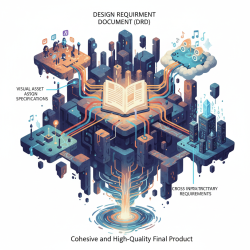
A well-structured Design Reference Document (DRD) is more than just a collection of technical specifications; it serves as the definitive blueprint for any successful project. It ensures clarity, facilitates collaboration, and acts as a single source of truth for all stakeholders, from developers and testers to project managers and business analysts. An effective DRD evolves alongside the project, meticulously detailing every aspect from high-level concepts down to granular implementation details. The art of structuring a DRD lies in organizing this vast information logically, making it easily navigable and comprehensible for its diverse audience.
Executive Summary and Introduction
Every robust DRD begins with sections that set the stage and provide immediate context. These initial sections are crucial for readers who need a quick overview or to understand the document's fundamental purpose before delving into specifics.
Executive Summary
The executive summary offers a high-level, non-technical overview of the entire design. It should concisely explain what the system is, why it's being built, its primary objectives, and the key architectural decisions. This section is particularly useful for executives and non-technical stakeholders who require a brief but comprehensive understanding without getting bogged down in technical jargon. It acts as a powerful abstract, summarizing the essential takeaways.
Introduction
Following the summary, the introduction formally outlines the document's purpose, scope, and target audience. It defines what the DRD covers and, equally important, what it does not. Establishing clear boundaries helps manage expectations and keeps the project focused. This section also often includes a brief overview of the document's organization, guiding the reader through its various sections.
Requirements and Architecture
These sections form the technical heart of the DRD, detailing what the system must do and how it will be built. They transition from the high-level project goals to the specific functional and structural aspects of the design.
System Requirements
This critical section enumerates all functional and non-functional requirements. Functional requirements describe what the system does, such as "The system shall allow users to log in." Non-functional requirements specify how the system performs, including performance, security, usability, and reliability aspects. Each requirement should ideally be clear, testable, and traceable back to business needs. Organizing these into categories or using unique identifiers significantly improves readability and traceability.
Overall System Architecture
Here, the high-level structure of the system is presented. This typically involves architectural diagrams (e.g., block diagrams, context diagrams, deployment diagrams) that illustrate major components, their relationships, and how they interact. It explains the chosen architectural style (e.g., microservices, monolithic, client-server) and the rationale behind it. This section provides a conceptual understanding of the system's blueprint before diving into individual components.
Data Model (Conceptual)
If the system involves data persistence, a conceptual data model is often included here. It outlines the key entities within the system, their attributes, and the relationships between them. This offers a foundational understanding of the data structure, independent of specific database technologies.
Components and Interfaces
This is where the design becomes granular, providing the specifics needed for actual implementation. It drills down into individual parts of the system.
Component Design
Each major component identified in the architecture section is detailed here. For each component, the DRD should describe:
- Its purpose and responsibilities.
- Its internal structure (sub-components, classes).
- Its interfaces (APIs, public methods) that expose its functionality to other components.
- Key design decisions and patterns used within the component.
This level of detail ensures that developers have a clear understanding of what needs to be built and how it fits into the larger system.
Interface Specifications
Detailed specifications for all internal and external interfaces are crucial. This includes APIs, data exchange formats (e.g., JSON, XML), communication protocols, and error handling mechanisms. Clear interface definitions are vital for enabling independent development of components and ensuring seamless integration. This section can include examples of API calls and responses.
User Interface (UI) Design
For systems with a user interface, this section details the UI/UX design. It can include wireframes, mockups, user flow diagrams, and specifications for visual elements and interaction patterns. The goal is to convey the user experience and ensure consistency across the application. Considerations for accessibility and responsiveness are also often addressed here.
Database Schema (Logical and Physical)
Expanding on the conceptual data model, this section provides the logical and physical database schemas. The logical schema defines tables, columns, data types, primary keys, foreign keys, and relationships, independent of a specific RDBMS. The physical schema then maps this to a particular database system, including indexing strategies, partitioning, and storage considerations. This is essential for database administrators and backend developers.
Implementation and Deployment Considerations
Beyond the pure design, a comprehensive DRD also touches upon how the design will be realized and operated.
Technology Stack
This section lists the specific technologies, programming languages, frameworks, tools, and libraries chosen for implementation. It often includes the rationale for these choices, considering factors like project requirements, team expertise, existing infrastructure, and scalability. Specifying the technology stack provides a clear direction for the development team.
Deployment Strategy
Details about how the system will be deployed are outlined here. This includes target environments (development, staging, production), deployment pipelines, release management processes, and scaling strategies. It might also cover containerization (e.g., Docker, Kubernetes) and cloud services. A clear deployment strategy ensures a smooth transition from development to live operation.
Security Considerations
A dedicated section on security addresses potential vulnerabilities and the measures taken to mitigate them. This covers aspects like authentication, authorization, data encryption, input validation, and compliance requirements. It demonstrates that security has been considered from the design phase.
Testing Strategy
This outlines the approach to quality assurance, including types of testing (unit, integration, system, acceptance, performance), test environments, and tools. A well-defined testing strategy ensures that the implemented system meets its requirements and performs as expected.
Supporting Sections
A DRD is strengthened by including administrative and supplementary information that provides context and clarity.
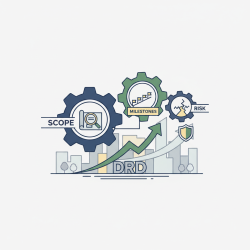
- Assumptions and Constraints: Documenting assumptions made during design helps in future decision-making and risk assessment. Constraints, such as budget, timeline, or technical limitations, also need clear articulation.
- Risks and Mitigations: Identifying potential technical risks and outlining strategies to mitigate them is proactive and crucial for project success.
- Glossary: A list of terms and acronyms used throughout the document, along with their definitions, ensures consistent understanding, especially in complex projects.
- References: A bibliography of any external documents, standards, or research papers that informed the design.
Summary
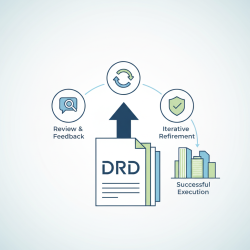
Structuring a DRD effectively is paramount for project success, providing a clear roadmap from conceptualization to implementation. By meticulously organizing essential sections such as the executive summary, detailed requirements, architectural diagrams, component specifics, interface designs, and critical implementation and deployment considerations, a DRD becomes an invaluable resource. This comprehensive approach ensures that all stakeholders possess a shared understanding of the system, fostering efficient development, streamlined communication, and robust, maintainable solutions.
Comprehension questions
 What is the primary purpose of the Executive Summary in a DRD, and for whom is it most beneficial?How do functional and non-functional requirements differ, and why is it important to include both in a DRD?What information should be included when detailing individual components within the Component Design section?Name two types of supporting sections that are crucial for a comprehensive DRD and explain their importance.
Community Poll
Next Lesson

Course Contents : The Design Requirements Document
- >> 3.
 Structuring Your Design Reference Document: Main Sections and Organization