Mastering Marketing and User Acquisition for Sustainable Growth
- -->> 6. Mastering Marketing and User Acquisition for Sustainable Growth
What you'll learn
 Marketing Plan DevelopmentAdvertising Channel SelectionUser Acquisition Funnel OptimizationData-Driven Marketing Metrics
Navigating the complexities of reaching target audiences, converting them into loyal users, and sustaining that growth requires a strategic approach that encompasses thorough planning, intelligent channel selection, and continuous optimization of the entire user journey. This article delves into the core components of building and refining these critical business functions, ensuring a clear path from initial outreach to successful user engagement.
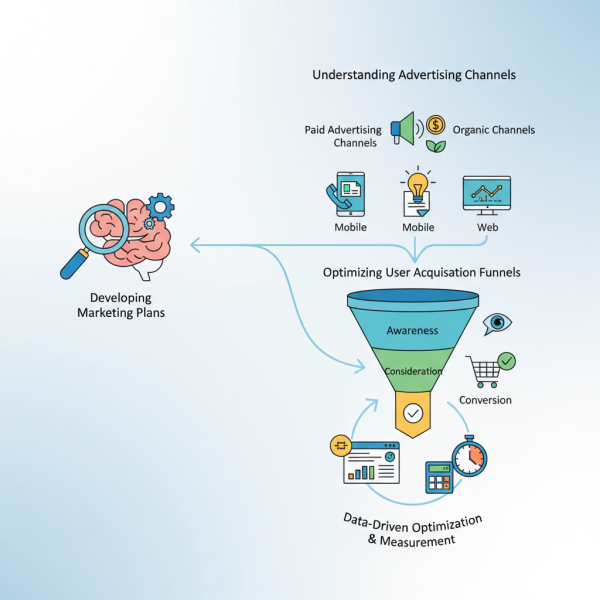
Developing Effective Marketing Plans
The foundation of any successful user acquisition effort begins with a well-defined marketing plan. This plan acts as a blueprint, guiding all subsequent actions and ensuring alignment with overarching business objectives. It necessitates a deep understanding of your market and your potential users.
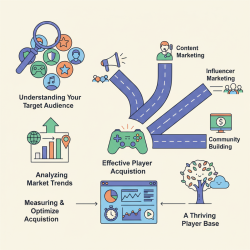
Firstly, identifying your target audience is crucial. Who are you trying to reach? What are their demographics, psychographics, pain points, and online behaviors? Creating detailed buyer personas can bring these insights to life, allowing for more precise messaging and channel selection. Understanding what motivates your ideal user is key to tailoring your marketing efforts.
Secondly, setting clear, measurable, achievable, relevant, and time-bound (SMART) objectives is essential. Whether it's increasing app downloads by 20% in the next quarter or achieving a 15% conversion rate on a specific landing page, concrete goals provide direction and allow for performance tracking. These objectives should align with broader business goals, such as revenue growth or market share expansion.
Finally, crafting a compelling value proposition distinguishes your offering from competitors. What unique benefits do you provide? Why should a user choose you over alternatives? Articulating this clearly across all marketing materials will resonate more deeply with your target audience, making your product or service irresistible. Market research plays a vital role in understanding competitive landscapes and identifying unique selling points.
Understanding Advertising Channels
Once a solid marketing plan is in place, the next step involves strategically selecting and utilizing advertising channels to reach your target audience. The digital ecosystem offers a diverse array of options, each with its own strengths and ideal use cases.
Paid advertising channels provide immediate visibility and granular targeting capabilities. These include:
- Search Engine Marketing (SEM): Primarily Google Ads, allowing businesses to appear at the top of search results for relevant keywords through pay-per-click (PPC) campaigns. This captures users with existing intent.
- Social Media Advertising: Platforms like Facebook, Instagram, LinkedIn, and TikTok offer sophisticated targeting based on demographics, interests, and behaviors, ideal for brand awareness and direct response campaigns.
- Display Advertising: Banners and visual ads placed on websites and apps across ad networks, effective for brand awareness and retargeting efforts.
- Native Advertising: Ads that blend seamlessly with the surrounding content, often found on news sites and content platforms, offering a less intrusive experience.
Organic channels, while requiring more time to yield results, build sustainable long-term growth and credibility. These include:
- Content Marketing: Creating valuable, relevant content (blogs, videos, infographics) to attract and engage a clearly defined audience, driving organic traffic and establishing thought leadership.
- Search Engine Optimization (SEO): Optimizing website content and technical aspects to rank higher in organic search results, increasing visibility without direct ad spend.
- Social Media Presence: Building an engaged community through consistent posting, interaction, and valuable content on relevant platforms.
- Email Marketing: Cultivating leads and existing users through targeted email campaigns, fostering loyalty and driving conversions.
The selection of channels should always be dictated by your target audience's online habits and your marketing objectives. A multi-channel approach often proves most effective, allowing for touchpoints across different stages of the user journey.
Optimizing User Acquisition Funnels
User acquisition is not just about attracting attention; it's about guiding potential users through a structured journey from initial awareness to conversion and beyond. This journey is often conceptualized as a funnel, and optimizing each stage is critical for maximizing efficiency and return on investment.
The top of the funnel (TOFU) focuses on Awareness. This is where you cast a wide net to attract as many potential users as possible. Activities here include broad paid ad campaigns, content marketing that addresses common pain points, and PR efforts. The goal is to get your brand or product noticed by the right people.
The middle of the funnel (MOFU) is about Consideration. Here, users who are aware of your offering begin to evaluate it. Strategies include providing more detailed content like case studies, webinars, product demos, or free trials. Email nurturing sequences can also play a significant role in educating prospects and addressing their concerns, building trust and demonstrating value.
The bottom of the funnel (BOFU) is where Conversion happens. This is the crucial stage where a user makes a purchase, signs up for a service, or downloads an app. Optimization here involves clear calls to action, seamless checkout processes, compelling offers, and addressing any last-minute hesitations. A/B testing of landing pages, button copy, and pricing models can significantly impact conversion rates.
It's important to view the funnel not as a linear path, but as a continuous loop, with feedback from each stage informing improvements upstream. Analyzing drop-off points in the funnel is essential for identifying bottlenecks and areas for optimization.
Data-Driven Optimization and Measurement
Effective marketing and user acquisition are inherently data-driven disciplines. Without robust analytics and continuous measurement, efforts remain speculative. Key Performance Indicators (KPIs) must be established and regularly monitored to assess the effectiveness of strategies and identify areas for improvement.
Critical metrics include Customer Acquisition Cost (CAC), which measures how much it costs to acquire a new user; Lifetime Value (LTV), representing the total revenue a business expects to earn from a single customer relationship; and various conversion rates across different funnel stages. Understanding the relationship between CAC and LTV is fundamental to sustainable growth.
Utilizing analytics platforms such as Google Analytics, mobile app tracking tools, and CRM systems allows businesses to track user behavior, campaign performance, and overall business health. A/B testing different ad creatives, landing page designs, and call-to-action placements provides empirical data to optimize performance incrementally.
The optimization process is cyclical: hypothesize, implement, measure, analyze, and refine. This iterative approach ensures that marketing spend is maximized and user acquisition efforts are continuously improving, leading to higher efficiency and better results over time.
Summary
Successfully acquiring and retaining users in today's dynamic market demands a strategic and data-driven approach. This article has outlined the critical steps involved, starting with the development of effective marketing plans that encompass target audience identification, SMART goal setting, and unique value proposition crafting. We then explored the diverse landscape of advertising channels, distinguishing between immediate-impact paid options and long-term organic growth strategies, emphasizing the importance of channel selection aligned with objectives. Furthermore, we delved into optimizing the user acquisition funnel, breaking it down into awareness, consideration, and conversion stages, highlighting key tactics for each. Finally, the necessity of data-driven optimization, leveraging KPIs, analytics, and iterative testing, was underscored as the cornerstone for continuous improvement and sustainable growth in user acquisition efforts.
Comprehension questions
 What are the key components involved in developing an effective marketing plan according to the article?Differentiate between paid and organic advertising channels, providing at least two examples for each.Describe the three main stages of the user acquisition funnel and the primary goal of each stage.Why is data-driven optimization crucial for marketing and user acquisition efforts, and what critical metrics are mentioned?
Community Poll
Next Lesson

Course Contents : Business of Running a Game Studio
- >> 6.
 Mastering Marketing and User Acquisition for Sustainable Growth